
Games Beyond Entertainment
Within this research theme, we situate all research on games and play where entertainment is not the main goal. Rather, games and play are studied in their capacity to persuade, steer, sell or in other ways influence the player through its design. This includes the many examples of serious games and gaming (educational, political, commercial) as well as the various forms and applications of gamification. We look both at the potential of, and provides critical reflection on these developments.

New minor “Games and Play in a Changing Society” open for registration
The new curriculum, which replaces the previous minor “Game Studies’, is a transdisciplinary collaboration between the Department of Media & Cultures studies (MCW), the Copernicus Institute of Sustainable Development and the Department of Information and Computing Sciences and enables students to analyze games and play in contemporary culture and to creatively apply them to address societal challenges.
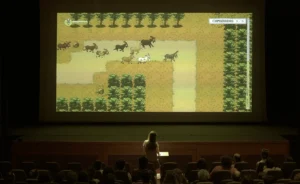
ASS POWER: Gaming at the Theatre
A review of Patrick Blenkarn and Milton Lim's 8 hour revolutionary donkey epic that sits between theatre and videogames. A collective gaming experience that will have you braying heeeee-haaaww while you contemplate issues of labor, automation, violence, and the good life.
Games-related treasures from De Schatkamer
On May 26, the Dutch Institute for Sound and Vision launched On May 26, the Dutch Institute for Sound and Vision launched De Schatkamer (‘Treasure Room’), a massive archive of the history of public broadcasting. In it we find a wealth of material related to games. This includes one of the first long documentaries on

Designing Social Interactions
This article explores how game studies scholars may apply their findings with a focus on the design of social interactions. Specifically, Molleindustria’s Casual Games for Protesters is analysed, looking at the ways in which its playful design undermines dominant narratives and invites new perspectives.
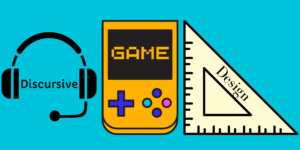
Making Game Studies’ Research Practical with Discursive Game Design
Co-creation of games, participatory design, open dialogue, and social perspective-taking currently lie at the centre of game research at Utrecht University. All these practices are characteristic of Discursive Game Design (DGD), a method that highlights the processes underlying practice-based game research, rather than a final "fixed" product.

Jamming for Climate Justice!
How do you simulate a climate crisis? How can you convey an ecocritical message that invites reflection and, perhaps, action? Participants of the Mzansi Game Jam (MGJ) developed games that addressed these questions from various angles.
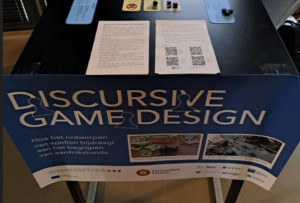
Shape2gether: Sharing our knowledge about discursive game design
Last November Aengus, Isabel and Mick visited two conferences to share some of the outcomes of the Erasmus+ hape2gether project with a broader audience.

New book on Historiographies of Game Studies
We would like to point you in the direction of a recently released edited volume titled Historiographies of Game Studies: What It Has Been, What It Could Be. The chapters in the book, two of which were authored by UU scholars, critically reflect on both the past and potential futures of game studies as a field.

Open Mind game challenges to look further
From now on, the Open Mind game, a creative educational game in the style of “whodunit”, is available in the Apple App and Google Play store. Students play the game on their own smartphones and receive mysterious messages from an unknown sender. By talking to various characters about their traits, values and beliefs, they have

Shape2Gether: Experiencing the Bochum Summer School
This is a reflection of the third and final “summer” school of the Shape2Gether Erasmus+ project that took place a month ago in Bochum, Germany.