
This article is the third of three parts in a broader research of practical applications of game studies’ findings in the Netherlands. You can find the first about Game Jams here, and the second about Discursive Game Design here.
In the previous articles, I have looked at game jam as a practical setting in which to apply findings of game studies. I have also analysed the DGD method, and compared it to the format of the Mzansi Game Jam. In this article, I explore how game studies scholars may apply their findings with a focus on the design of social interactions. Specifically, I analyse Molleindustria’s Casual Games for Protesters, and the ways in which its playful design undermines dominant narratives and invites new perspectives.
This article consist of two parts. First, I discuss the notion of designing social interactions in a playful manner with the use of Jaakko Stenros’ and Johanna Koljonen’s notion of the “human encounter as designable surface.”1 I then move to Larry M. Bogad’s notion of “tactical carnival,” to highlight how subversive play can challenge hegemonic ways of thinking.2 Second, I analyse the human encounter in Molleindustria’s Casual Games for Protesters, and what aspects of the tactical carnival can be recognised in the games.
Stenros and Koljonen approach social situations from a design perspective: they write that the social encounter, the space it takes place in, or “…any aspect of an experience or situation” can be designed – and can thus be considered a designable surface.” They give live action role-playing games (LARPs) as an example of a situation where social interaction is consciously designed. While the design of LARPs limits agency by imposing rules of play, it also imbues actions taken during play with meaning; as players are incentivised to “embody skills and qualities” they might not possess outside of play. However, both participation and experience design share an important role in creating meaning, as they shape the social frame in which play happens which can contribute to mutual understanding between players. These insights can be applied in other area’s than role-playing; they can help shape experience design in other fields, like “…formal education and civic participation processes.”3
An example of a playful civic participation process is the practice of counter protests, which employ subversive acts of play to challenge dominant narratives. Performance artist and scholar Larry M. Bogad describes how social movements can employ oppositional tactics part of a “repertoire of contention” during public demonstrations. Innovative oppositional tactics can be disruptive, which may undermine the typical response of opponents, surprise them, and shift sympathy towards the oppressed. To describe acts of ludic protest, Bogad uses the concept “tactical carnival.” Bogad describes it as tactical since the protestors who organise carnivalesque actions have more “tactical agency” in deciding where and with whom the action takes place, setting it apart from earlier notions of the carnivalesque where there was no divide between performer and audience. Because of this tactical agency, counter protests are able to communicate their agenda with more precision, and in ways that are not always possible with modulated tactics like the public demonstration.4
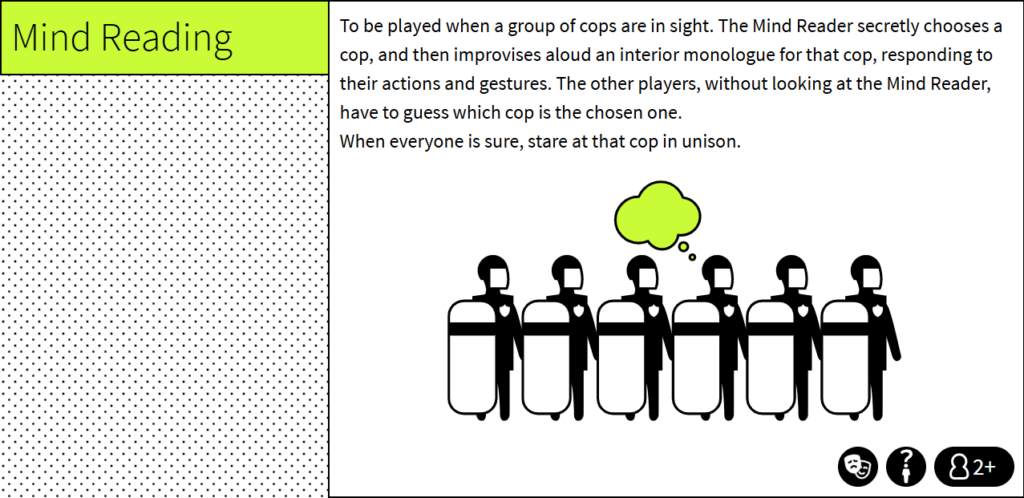
Molleindustria’s Casual Games for Protestors can be taken as a toolset for instigating subversive acts of play during protests. A collection of original games, variations of games, and games taken from the repertoire of contention of activist groups like the Clown Army, Casual Games for Protestors functions as a guide to making acts of ludic protest more approachable to protestors. Molleindustria is the pseudonym of Paolo Pedercini, who has worked on disruptive short experimental games, playable theories, and agitprop games since 2003, some of which have received broad attention (McDonald’s Video game, Oiligarchy).5 The goal of Casual Games for Protestors is to make participation in social games “…exhilarating, social, intellectually and physically stimulating, liberatory and fun”(Italics in original).6 Because the games are casual and often require little to no preparation, it functions as a general repertoire of contention for a broad group of protestors.
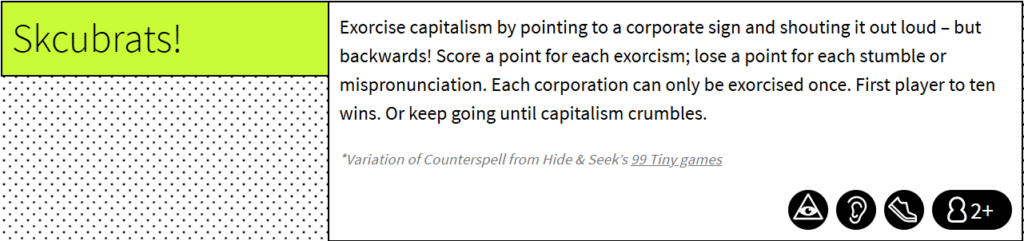
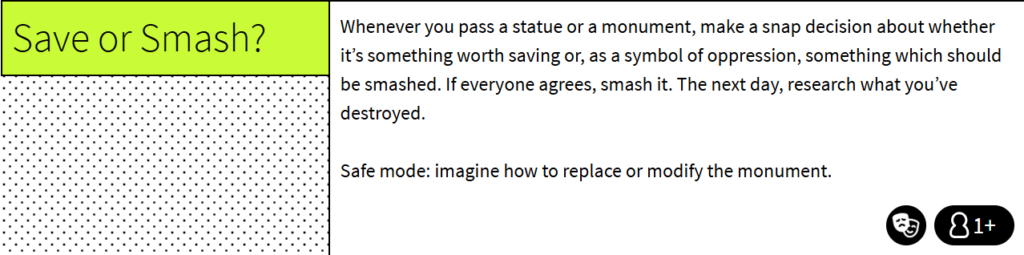
When the collection of subversive, ludic acts of play in Casual Games for Protestors is adopted by protestors, it designs social interaction during a protest. Players are encouraged to adopt behaviour diverting from modular protest tactics, challenging authority and opponents in the process. These ludic actions range from being relatively unintrusive (shouting out corporation names in reverse) to destroying public property and being downright illegal.7 Players can be said to perform acts of tactical carnival, as they subvert modular protest tactics but maintain agency when, where, and with whom their actions take place. Moreover, those engaged in one of the casual games are often the only ones aware of the rules of the game, creating distance between performer and audience. That being said, some games include agents not aware of the rules within play, like when a police officer is observed or mimicked. These games are more carnivalesque, as they blend the role of performer and audience. Yet this only happens when those aware of the rules of the game start their play.
In this article I have analysed Molleindustria’s Casual Games for Protestors as case study for the application of game studies research in the design of social interaction. By employing subversive acts of play within the context of a public demonstration, Casual Games for Protestors invites behaviour that challenges and undermines normative responses from opponents. This type of design is one of the ways in which game research can apply its theory in a practical setting.
About the author:
Marijn Benschop is a New Media and Digital Culture Master student at Utrecht University. He wrote this article series as part of his internship at the Center for Game Research. He also co-organised Dutch DiGRA 2025.
- Stenros, Jaakko, and Johanna Koljonen. “The Human Encounter as a Designable Surface: Leveraging Insights from Larp Design to Enable Democratic Participation.” (paper presented at DiGRA, Malta, July 2025), 1. ↩︎
- L.M. Bogad. “Tactical carnival: Social Movements, Demonstrations, and Dialogical Performance.” in A Boal Companion. Eds. Cohen-Cruz, Jan, and Mady Schutzman. London: Routledge Press, 2006. 46-58. ↩︎
- Stenros and Koljonen. “The Human Encounter.” 1-2. ↩︎
- Bogad. “Tactical Carnival.” 49-50, 56-7. ↩︎
- https://www.molleindustria.org/blog/about/ ↩︎
- https://www.protestgames.org/ ↩︎
- Ibid. ↩︎