ASS POWER: Gaming at the Theatre
Asses.masses is a 7–8 hour videogame performance by Canadians Patrick Blenkarn and Milton Lim, programmed at SPRING Performing Arts Festival in Utrecht. It had been on my radar for months after coming up in my intermediality and media comparison class as an example of the theatricalization of gameplay.
I have a wary relationship with theater. As a fan of role-playing games and a larper to boot, I often find that ‘interactive theater’ leaves me wanting more (“oh, so you can vote on the outcome? such interactivity, much participation…”). But Asses.masses delivers on its promise: it evokes a real sense of collectivity and offers a nuanced exploration of work and the good life. Let me set the scene.
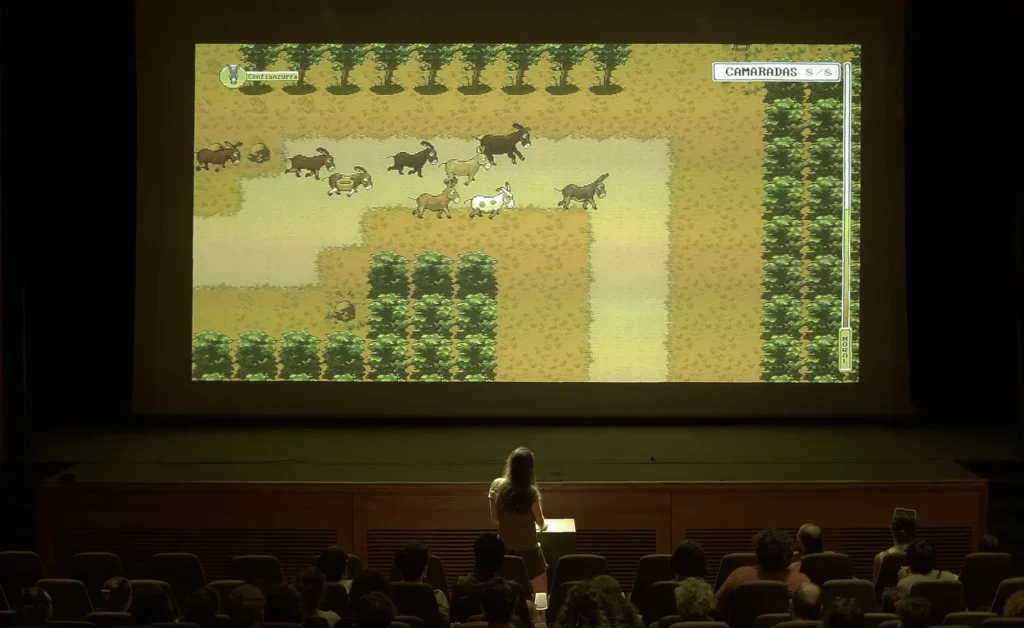
An auditorium. We are a herd, 100 strong. After a brief, almost offhand introduction by Blenkarn and Lim, the lights dim except for a spotlight aimed at a lectern holding a wireless controller. The screen zaps to life. Press (X) to continue, it reads. There’s a brief silence until, from among the herd, a young man rises. We all clap. For the next 20 minutes, he becomes our representative.
When I used to play videogames with my ex, we would pass the controller back and forth (“You drive the bus,” I’d tell him while I refreshed our drinks). This is also how you play Asses.masses. The player at the lectern, hands on the controller, merely executes the will of the people. Sometimes the choice is easy, when the crowd shouts in unison; sometimes it’s put to a quick vote: do we say this or that? Go left or right? Even if you don’t have your hands on the controller, you’re still playing—an affirming experience for a back-seat gamer like me.
What’s more, there are other parts to play. Asses.masses recounts the struggle of a group of donkeys facing automation and the loss of their jobs. In our showing, this cast of quirky characters was performed by us. Without explicit prompting, several audience members claimed characters and read their lines aloud, keeping the dialogue flowing and the audience immersed. (Shout-out to Nice Ass, Kick Ass, Sturdy Ass, and Lidl Ass: you should be voice actors for real!) While the writing is excellent, I can’t emphasize enough how much these strangely disembodied voices, calling out from the darkened stands of the auditorium, brought the characters to life.
Throughout the experience, the cohesion of the herd waxed and waned. At moments — shouting ASS POWER and galloping toward the village to confront the humans with our demands — I felt it strongly. But during the intervals, when food and drinks were served, I felt more set apart. The breaks had no fixed time limit and only ended once we, as a herd, drifted back into the auditorium. This pitted my gaming endurance and hyperfocus against the indulgent, yappy Dutch borrelcultuur. These were the only moments when I wished our herd came with a shepherd who could have gently ushered everyone back to their seats.
There were also moments when individuals were singled out, for example during the game’s challenging mini-games: a deviously difficult game of Pong, a rhythm game, and several puzzles. In moments like these, the herd closed ranks around the player at the lectern and cheered them on until they made it through.
Ultimately, Asses.masses succeeds because it draws on collective gaming practices that feel entirely ordinary. Passing the controller around, arguing over dialogue choices, shouting directions from the sidelines, solving puzzles together—these are habits many players already know by heart. Blenkarn and Lim do not initially frame any of this as anything special. They hand over the reins, with barely any instruction, and allow the audience to fall into familiar rhythms of collective play. But then, over the course of seven hours, these mundane acts of coordination begin to take on real political and emotional weight. The crowd learns how to deliberate, compromise, encourage, and occasionally fail each other. By the time the game confronts the herd with difficult open-ended questions about labor, reparations, or what kind demands we should make of the future, collective decision-making no longer feels like a gimmick or mechanic. It feels powerful. Asses.masses reveals that there is something genuinely radical in the simple act of figuring things out together.
This review was originally posted on the Utrecht Game-lab’s Substack page. Check it out here to read more and to sign up for the Game-lab newsletter.
About the author:
Dr Laura op de Beke is Assistant Professor of Interactive Media, Screens, and Interfaces at Utrecht University. You can read more of her work at www.lauraopdebeke.com